

INTRODUCTION
The supplement industry is massive, if you didn’t already know that. In fact, the 2024 dietary market size (USA) was valued in excess of 93 billion dollars.1 Of course, supplements have a time and a place as part of your diet (food-first approach always).
But, how can you be assured that your supplement actually has what the label claims it has? And how can you be sure it is free of other substances you may not want (i.e., heavy metals)? If you haven’t been considering these questions, I am urging you to begin that process now.
Have a little read on previous articles I wrote on this subject.
ARTICLE LINK: Supplement Quality and Regulation
ARTICLE LINK: Botanical Products: Toxicity and Safety
ARTICLE LINK: Botanicals: Exploring Risks of Toxicity
ARTICLE LINK: Botanical Medicine and Regulations

GIVE ME THE DETAILS
There is good news! There are third party (no affiliation with a supplement company) organizations that exist to help solve the issues outlined above (i.e., potency/purity of a product). This is a relief because the supplement industry is big, and continues to grow especially among older adults.2
People are increasingly interested in optimizing their health, rather than simply being free from illness. People are also aware that fruits and vegetables are becoming depleted in micronutrients from exhaustive monocropping techniques.3 (Don’t believe me? Read the article below). This creates a situation where supplementation becomes a reasonable option.
ARTICLE LINK: Potassium Deficiency: Causes and Methods of Repletion
THIRD PARTY CERTIFICATION
Alright, here we go. So, there are a lot of certifications for supplements out there. However, I am interested in providing you with a certification (see image above) that is robust. NSF-certified supplements will help reassure you of a quality purchase. NSF stands for National Sanitation Foundation; a public health organization that tests and certifies foods, water, and consumer products.4
Did you know that NSF was founded in 1944 and has certified over 657,000 products, conducted over 300,000 audits per year, and has published over 160 standards and protocols?4 Well now you do! Standards are high, and supplement companies that hold the NSF stamp must have the manufacturing facilities inspected at least twice per year.4 Before we dig deeper, I want to take a step back. Keep reading.
GOOD MANUFACTURING PRACTICES (GMP)
Now, the government (separate from NSF) does have a standard for all supplement companies to abide by, and it is called Good Manufacturing Practices (GMP).5 GMP standards ensures that supplements are consistently produced in a way in which company claims match what is actually produced.6
GMPs are important because they specifically define measures for quality control and production of supplements.6 They also have legal components which outlines responsibilities for responding to defects and complaints, and responsibilities for manufacturing, testing, and distribution.6

WHY HAVE NSF, IF GMP ALREADY EXISTS?
Great question! One big reason is that a supplement company can have a third party pass it as GMP certified… or the company can do a self-assessment.8 The second option seems like it has an increased possibility for errors and/or bias. I do not want to throw companies “under the bus” with this statement, as I am sure there are many companies that offer consistent, high quality products that also perform self-assessments for GMP certification.
However, it IS important to me that I provide a roadmap to choosing supplements that minimize risk of harm to you. Having an NSF designation (meaning a third-party organization inspects all aspects of a supplement manufacturing company) adds a layer of certainty regarding quality and safety of the supplement you are considering.
CONCLUSIONS
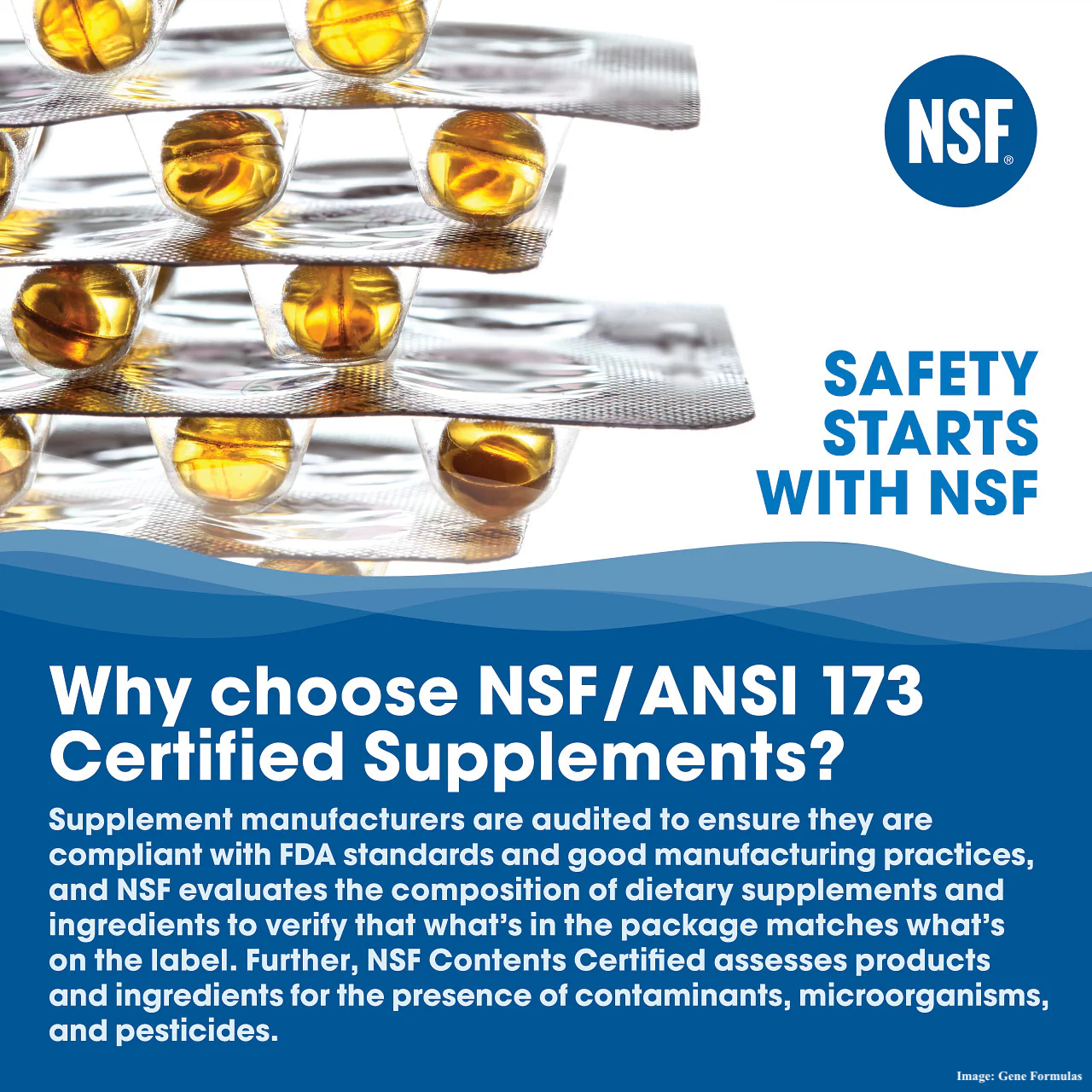
As you can see, it is really good idea to think about the quality and safety of supplements you are purchasing and consuming. Supplement companies that choose NSF will have the benefits of avoiding costly recalls and warning letters from government agencies (i.e., FDA); NSF consultants will provide pre-audit reviews and other services to make sure they are compliant.9
NSF consultants will also help make sure supplement manufacturing companies design their facilities in a way that meets regulatory standards; this helps avoid costly redesigns.9 Finally, NSF can help streamline supplement manufacturing processes.9 In the end, the consumer (YOU) wins.
Hopefully you have a little more knowledge, and are a little more informed about what to look for when purchasing a supplement from a company. I hope you found this article helpful, and best of luck in your health journey!
-Michael McIsaac
References
1. Fortune Business Insights. https://www.fortunebusinessinsights.com/dietary-supplements-market-102082. Accessed Dec 8, 2025.
2. Coates PM, Bailey RL, Blumberg JB, et al. The evolution of science and regulation of dietary supplements: Past, present, and future. J Nutr. 2024;154(8):2335-2345. doi:10.1016/j.tjnut.2024.06.017.
3. Sarkar GK, Debnath A, Chattopadhyay AP, Sanyal SJ. Depletion of soil potassium under exhaustive cropping in inceptisol and alfisol. Commun Soil Sci Plant Anal. 2014;45(1):61-72. doi:https://doi-org.libproxy.bridgeport.edu/10.1080/00103624.2013.848880.
4. NSF. https://www.nsf.org. Accessed Dec 29, 2025.
5. Government of Canada. Good manufacturing practices guide for natural health products gui-0158): Overview, about NHP quality systems. https://www.canada.ca/en/health-canada/services/drugs-health-products/compliance-enforcement/good-manufacturing-practices/guidance-documents/guide-natural-health-products-0158.html. Published Sept 4, 2025. Updated Sept 4, 2025. Accessed Dec 29, 2025.
6. World Health Organization. Good Manufacturing Practices. https://www.who.int/teams/health-product-policy-and-standards/standards-and-specifications/norms-and-standards/gmp. Accessed Dec 30, 2025.
7. Al Azawei A, Loughrey K, Surim K, Connolly ME, Naughton BD. The management of good manufacturing practice (GMP) inspections: A scoping review of the evidence. Front Med (Lausanne). 2025;12:1-13. doi:10.3389/fmed.2025.1687864.
8. Government of Canada. Good manufacturing practices for drug products (GUI-0001). https://www.canada.ca/en/health-canada/services/drugs-health-products/compliance-enforcement/good-manufacturing-practices/guidance-documents/gmp-guidelines-0001/document.html. Accessed Dec 31, 2025.
9. NSF. GMP regulatory compliance. https://www.nsf.org/nutrition-wellness/gmp-regulatory-compliance. Accessed Dec 31, 2025.